
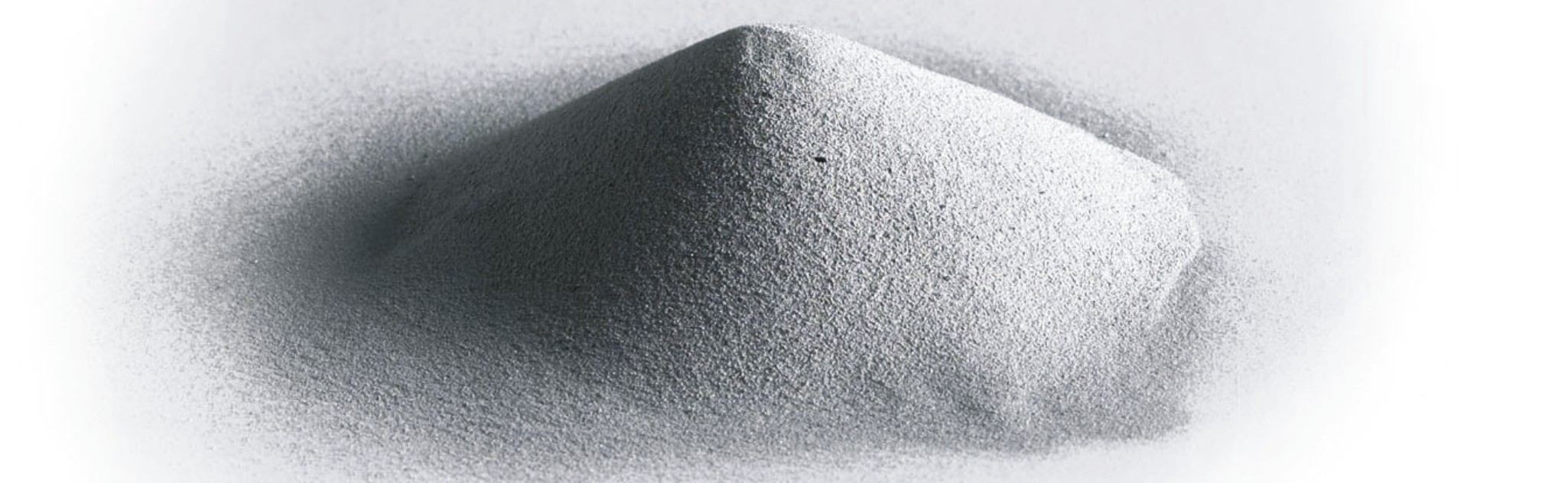
Selecting the right metal powder is one of the most critical decisions in any powder-based manufacturing process. Whether you are producing sintered components, brazing assemblies, formulating diamond tools or developing additive manufacturing applications, the characteristics of your metal powder will directly influence the quality, performance and cost-effectiveness of your final product.
This guide examines the key properties you should evaluate when choosing a metal powder, and how each parameter affects downstream processing and end-product performance.
Particle Size Distribution
Particle size distribution (PSD) is perhaps the single most important specification for any metal powder. It determines packing density, sintering behaviour, surface finish and mechanical properties of the finished part. PSD is typically measured by sieve analysis or laser diffraction and expressed as a range (e.g., -150/+45 microns).
Fine powders (below 45 microns) offer higher surface area, faster sintering kinetics and better surface finish, but they can be more difficult to handle due to reduced flowability and increased risk of oxidation. Coarse powders (above 150 microns) flow more freely and are easier to process, but they sinter more slowly and produce rougher surface textures.
For powder metallurgy press-and-sinter operations, a typical PSD of -150/+45 microns provides a good balance. Additive manufacturing processes such as selective laser melting generally require tighter distributions in the 15-45 or 15-63 micron range. Diamond tool manufacturers may specify powders in the -63/+20 micron range for optimal segment density.
Particle Shape and Morphology
The shape of metal powder particles has a profound impact on processing behaviour. Three primary morphologies are encountered in atomized metal powders:
- Spherical particles are produced by gas atomization and offer excellent flowability, high apparent density and uniform packing. They are the preferred choice for additive manufacturing, metal injection moulding (MIM) and brazing pastes where consistent flow and dense packing are essential.
- Irregular particles result from water atomization and feature rough, angular surfaces. These particles interlock during compaction, providing superior green strength in press-and-sinter applications. Irregular copper and bronze powders are the standard for structural PM parts, friction materials and self-lubricating bearings.
- Dendritic particles have a branched, tree-like structure that provides very high green strength and excellent interlocking. Dendritic copper powders are widely used in electrical contacts, conductive fillers and applications where maximum particle-to-particle contact is required.
Apparent Density and Flow Rate
Apparent density (AD) measures the mass of powder that fills a given volume under gravity, typically expressed in g/cm³ and measured using a Hall flowmeter funnel according to ISO 3923. A higher apparent density means more material per unit volume, which translates to less shrinkage during sintering and more dimensionally predictable parts.
Flow rate, measured by the time it takes for 50 grams of powder to pass through the Hall funnel (ISO 4490), indicates how easily the powder can be fed into dies, hoppers and deposition systems. Spherical powders exhibit the best flow rates, while irregular and dendritic powders flow more slowly or may not flow at all through the standard funnel.
For automated pressing operations with high cycle rates, a Hall flow rate below 30 seconds per 50 grams is typically required. Additive manufacturing systems demand even better flowability to ensure uniform layer deposition.
Chemical Purity and Composition
The chemical purity of a metal powder directly affects the properties of the sintered component. Oxygen content is particularly critical: elevated oxygen levels can form oxide inclusions that weaken the microstructure and reduce electrical and thermal conductivity. For copper powders, a typical specification is Cu ≥ 99.5% with oxygen below 0.3%.
For alloyed powders such as bronze (CuSn) or brass (CuZn), the exact alloy composition must match the target specification to ensure consistent mechanical properties. Pre-alloyed powders, where each particle contains the correct alloy ratio, offer better homogeneity than elemental mixtures, particularly for demanding applications like diamond tool segments.
Application Matching: Practical Examples
Powder Metallurgy (Press & Sinter)
For structural sintered parts, irregular water-atomized copper or bronze powders in the -150/+45 micron range provide optimal green strength and sintering behaviour. MEPOSO offers a comprehensive range of water-atomized grades specifically engineered for PM applications.
Brazing and Soldering
Brazing applications require spherical, gas-atomized powders with tight particle size distributions for uniform paste formulation. MEPOSO gas-atomized copper and bronze powders deliver the consistent spherical morphology and controlled PSD that brazing paste manufacturers demand.
Diamond Tools
Diamond tool segments require pre-alloyed bronze powders with carefully controlled composition and fine particle size to achieve the right matrix hardness and diamond retention. MEPOSO pre-alloyed bronze powders are specifically designed for hot-press and cold-press diamond tool production.
Additive Manufacturing
Metal 3D printing demands highly spherical powders with narrow PSD (typically 15-45 or 15-63 microns), excellent flowability and low oxygen content. MEPOSO gas-atomized powders meet the stringent requirements of laser powder bed fusion and directed energy deposition processes.
Making the Right Choice
Choosing the right metal powder requires balancing multiple parameters against your specific application requirements. Start by defining your target properties: what particle size range does your process need? Is green strength or flowability more important? What purity level does your application demand?
MEPOSO's technical team can help you navigate these decisions. With decades of experience in metal powder manufacturing and a product range that spans water, gas and air atomized powders in copper, bronze, brass, tin and many other metals, we offer the expertise and the product portfolio to match your exact requirements.
Contact our technical team to discuss your application requirements and receive a tailored recommendation.