Flexible radiation shielding is used where rigid metal plates are not practical: protective curtains, drapes, wearable barriers, scanner accessories and security systems often need to bend, fold, sew, laminate or weld while still delivering repeatable attenuation. In these systems, metal powder selection is tied not only to nominal chemistry but also to particle size distribution, dispersion quality, loading capability and the final compound behaviour during converting.
Why high-density powder is central in flexible shielding compounds
Flexible shielding compounds rely on dense metal loading because attenuation has to be achieved without turning the product into a rigid plate. The practical job is to reach the target energy window and area weight while keeping the sheet or coated textile workable. This is why buyers compare not just chemistry, but also particle size distribution, apparent density, packing behaviour and the stability of the powder inside polymer or elastomer systems.
Where lead powder still fits and why bismuth routes are compared
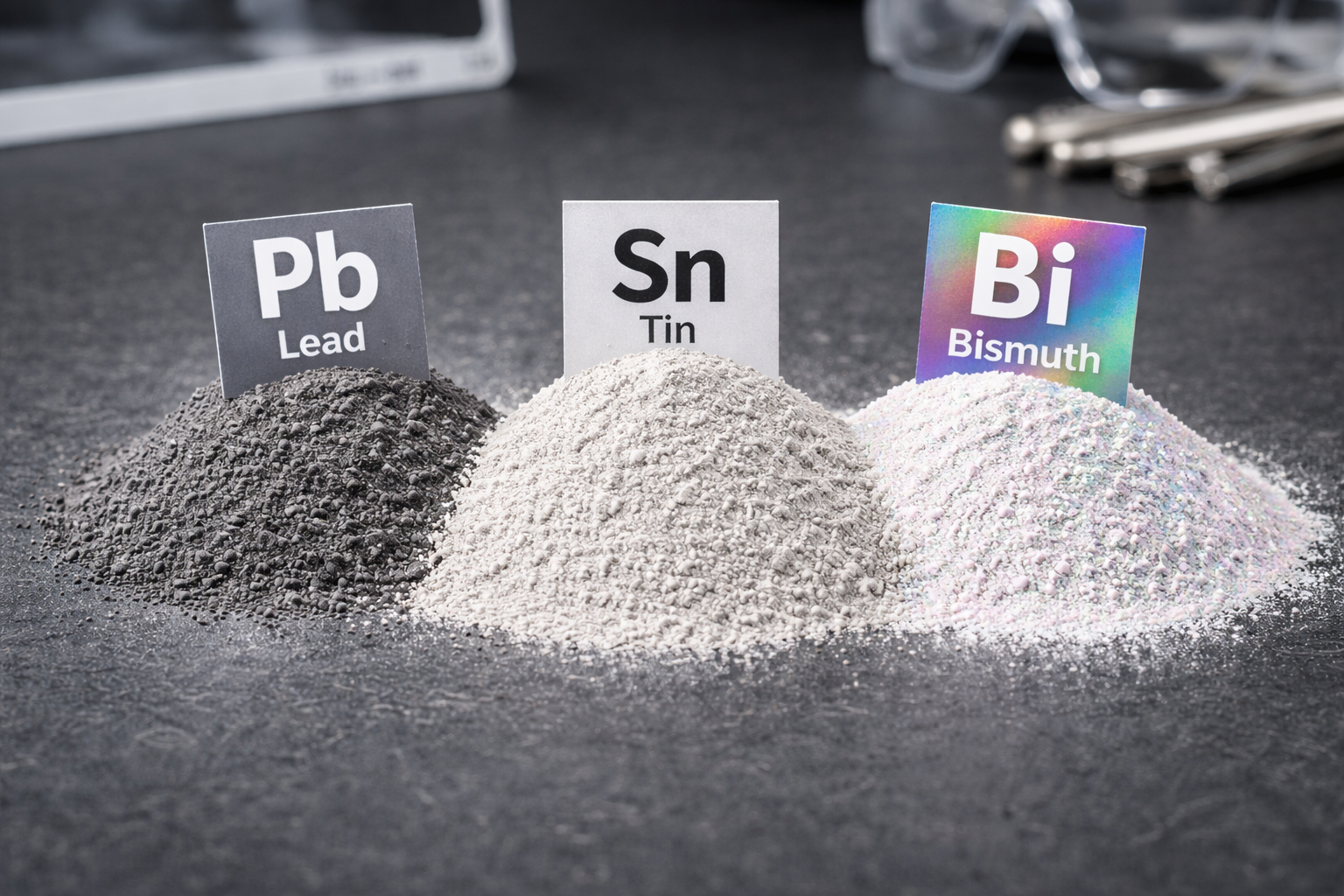
Lead powder remains a reference in flexible shielding because density and attenuation efficiency are strong, well-known and industrially established. At the same time, many projects compare bismuth-based routes because market, regulatory or end-use requirements may push toward lead-free positioning. The technical comparison is never just about replacing one metal with another: it also involves loading level, compound rheology, flexibility after curing, joining behaviour and the final attenuation result in the target energy range.
Why tin powder can matter in these formulations
Tin powder is not usually discussed as a direct one-to-one replacement for the main shielding filler, yet it can still matter in flexible systems. It may support broader metallic packages where softness, compatibility, wetting behaviour or response in the compound architecture matter to the converter. In practice, technical teams assess tin in relation to dispersion, mixing stability, lamination and the mechanical feel of the final sheet, rather than looking at density alone.
What converters and buyers usually verify before qualification
Qualification work usually goes beyond a certificate check. Teams verify repeatability from batch to batch, contamination control, powder behaviour in mixing, calendering or coating, and the way the finished structure performs after sewing, cutting or welding. The relevant question is whether the powder route stays stable inside the real converting process and supports the required attenuation result without creating unnecessary weight or stiffness.
MEPOSO can support technical discussion on lead, tin, bismuth and adjacent metal-powder routes for flexible radiation shielding compounds.